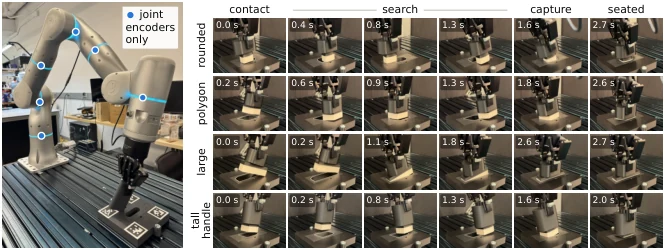
An October 16 preprint examines whether joint-position and velocity histories can guide precise assembly. The studied policies observe their own actions and proprioceptive measurements, without visual, force, torque or tactile sensors in their inputs. They are trained with reinforcement learning in simulation across varied parts, grasps and contacts.
The authors describe peg insertion, gear meshing and nut threading in simulation. For insertion transferred to a real robot without further training, they report 73% success across 237 trials. That result belongs to this insertion protocol; it should not automatically be applied to the other assemblies or a complete industrial production line.
Matched simulation comparisons suggest better generalisation to some unseen shapes and sizes than visual policies, sometimes with slower execution. The authors also announce a MuJoCo part generator intended to preserve mechanical clearances in simulation. The opportunity is exploiting information already available inside the robot; robustness, throughput and safety still need establishing under intended production conditions.